Showing posts with label 9-1-1. Show all posts

Tuesday, October 7, 2014

CRESA Celebrates Four Life Saving Awards

Here at CRESA we are very proud of our dedicated and highly professional team.  From time to time we get the opportunity to spotlight a few of those individuals who do an amazing job daily and in these cases, helped save a life.

The Life Saving Award is given to a 9-1-1 Dispatcher who use Emergency Medical Dispatch (EMD) Protocols to give lifesaving instructions to a caller and the patient survives.  In the cases highlighted here,  Dispatchers quickly recognize the need for CPR and instructed the callers on how to start chest compression's while keeping them calm, reassured and focused until paramedics arrive. 


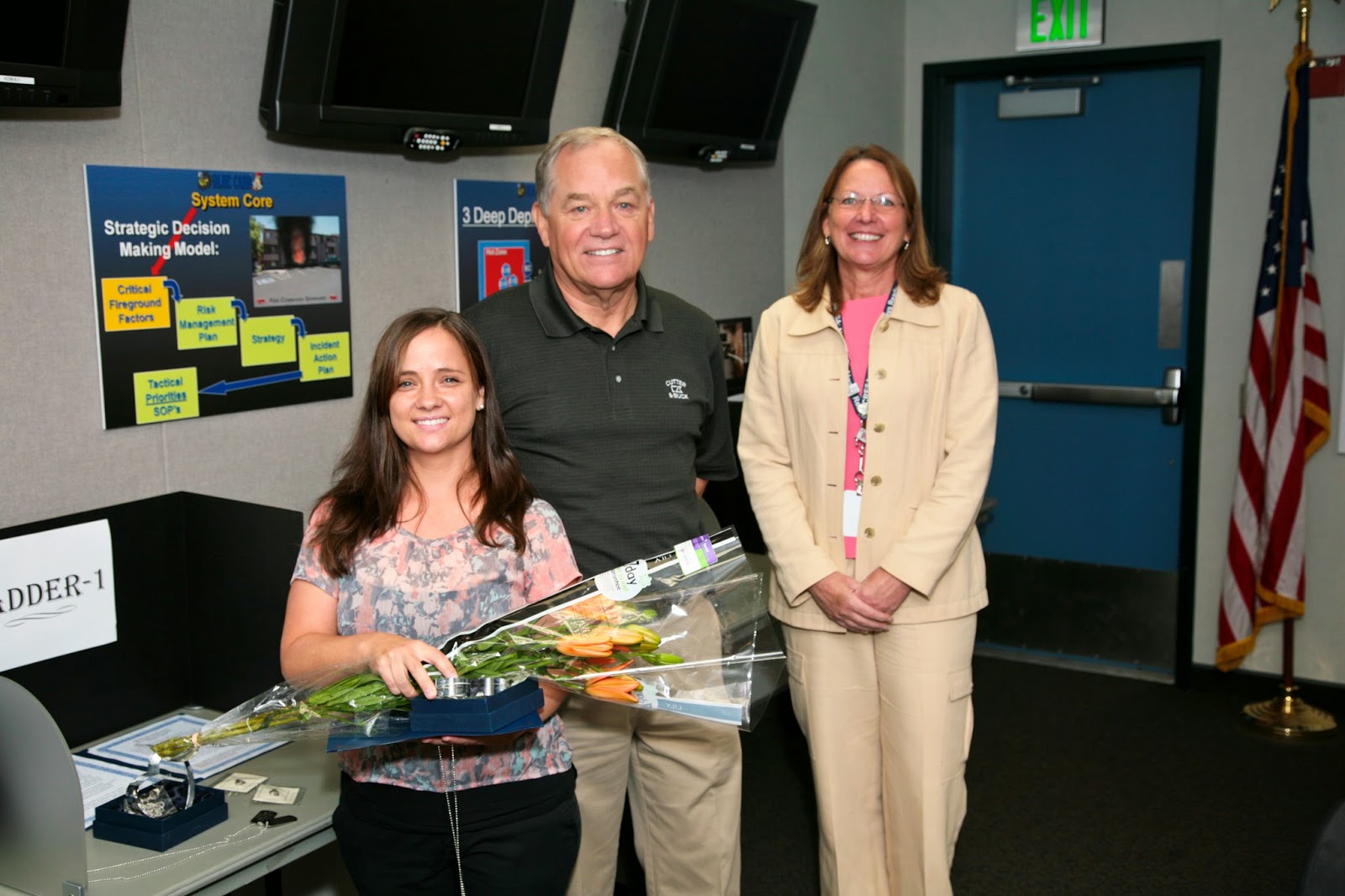
During last week's CRESA Board of Directors Meeting, three 9-1-1 dispatchers were awarded the Life Saving Award... 


Sally Dexter:  
Pictured Left to Right: Sally Dexter; CRESA Board Chair,
Don Cheney; CRESA Director, Anna Pendergrass 

Sally answered a 9-1-1 call from a male subject who stated he needed and ambulance for his friend who is down on the ground and blue.  l   After some time in the hospital the patient was released from the hospital and sent home independently.  


Pictured Left to Right: Kira Yager; CRESA Board Chair, 
Don Cheney; CRESA Director, Anna Pendergrass 
Kira Yager:

Kira answered a 9-1-1 call with woman who was very upset trying to report her 16 year old son was unconscious and not breathing.


Jackie Piggot:  (Receiving two awards)
Pictured Left to Right: Jackie Piggot; CRESA Board Chair, 
Don Cheney; CRESA Director, Anna Pendergrass 

1st Award:
Jackie answered a 9-1-1 call  with a male caller who was reporting his 48 year old girlfriend unconscious and not breathing.  .

2nd Award: 
Jackie answered a 9-1-1 call with a female caller who was reporting her boyfriend was unconscious and not breathing normally.  The patient was transported to the hospital and then left the hospital against medical advice, he did have relatively normal neuro functioning upon leaving.


These four awards highlight the importance of early CPR in saving lives in Clark County!!  We continue to encourage everyone to be trained in Hands Only CPR.  Take a minute to watch the Hands-Only Demo  below,  your knowledge could save a life!! 


Tuesday, June 11, 2013

I Know My Address, However Does Your Child?

This time of year marks a spike in community events, and here at CRESA, we are always happy to share important information in regards to better preparing  for  emergencies  or what you need to know when you have to call 9-1-1.  Over the past couple weeks, CRESA Public Educators have been out in full force, as we share information  during our partners Open House events.

At one of these events I recently worked, I had the opportunity of chatting with a couple hundred  young kids.  As I shared 9-1-1 stickers, temporary firetruck tattoos and coloring pages,  I would ask them the question, "What number do you call in an emergency if you need help?"  Almost all of them knew the answer of "9-1-1." This usually would be followed by,  "Do you know your address?"  Sometimes I would get a shrug of the shoulders or a nodding of the head, sometimes "yes", sometimes "no."  I had several parents urge their kids, asking them, to tell me if they knew.  As they would respond, I would hear telephone numbers rattled off or perhaps a house number, but very few times did I hear a complete address. During our little discussions in the few minutes I had before their attention was distracted by a shiny fire truck or the Law Enforcement K-9's,  I would share why it was important for them to know their address, and the importance this plays in helping  9-1-1 dispatcher's know where to send the help!

As the day went on, it got me thinking.  Little things like learning our phone number and address easily slip through the cracks with all the technology we have at our fingertips.  I can tell you from personal experience, there are very few phone numbers I honestly still have memorized. They are all conveniently stored in my smartphone.  To this day, I still glance each time I give out my work cell number.  Its just one of those numbers I take for granted.  Yet if you ask me my childhood phone number or address, I can rattle them, along with my grandparents numbers off with ease. No matter where we keep these important pieces of information, to have them handy, nothing replaces having them stored to memory when you need them.  For me learning needs to be interesting and fun.   Doing a little research, I found some great fun ideas for you to use with your child in helping them learn their address. I hope the following ideas are useful in teaching your child important information that could be invaluable in an emergency.  I know I may practice a couple of these myself.

Step 1

Point out the numbers on the side of your home and the street signs in your neighborhood. Say your address so that your child hears it and sees the street name and numbers together.

Step 2

Cut out a house shape from a piece of paper. Write the address in large print so it's easy to read. Hang the house picture in your child's room so he sees it every day and becomes familiar with it.

Step 3

Hand your preschooler a stack of envelopes so he can practice writing his address. Writing down the information may help it stick because he gets the repetition along with the visual of the numbers. If your economy friendly side cringes at using all that paper, laminate an envelope and use a dry erase marker so he can write, erase and repeat.

Step 4

Rhyme the address to make it easier to remember. For example, for the address 321 May St., say, "I have fun at 321; I play all day on a street called May." The rhyme doesn't have to make sense as long as it gets your child excited about learning his address.

Step 5

Belt out a tune about your address. Like rhymes, songs make it easier to commit the address to memory. Make up your own tune, or use your child's favorite song. Don't worry if you're off key. Your preschooler won't notice, but he will have an easier time learning his address.

References


Tuesday, April 10, 2012

A Tribute to Dispatchers

This tribute was written in 1994 in one of the early years of officially recognizing Public Safety Telecommunicators.  Its sentiments are still relevant today (even if some of the references are dated).
 

By Chief Thomas Wagoner
Loveland (Colorado) Police Department


Someone once asked me if I thought that answering telephones for a living was a profession. I said, "I thought it was a calling."

And so is dispatching. I have found in my law enforcement career that dispatchers are the unsung heroes of public safety. They miss the excitement of riding in a speeding car with lights flashing and sirens wailing. They can only hear of the bright orange flames leaping from a burning building. They do not get to see the joy on the face of worried parents as they see their child begin breathing on its own, after it has been given CPR.

Dispatchers sit in darkened rooms looking at computer screens and talking to voices from faces they never see. It's like reading a lot of books, but only half of each one.

Dispatchers connect the anxious conversations of terrified victims, angry informants, suicidal citizens and grouchy officers. They are the calming influence of all of them-the quiet, competent voices in the night that provide the pillars for the bridges of sanity and safety. They are expected to gather information from highly agitated people who can't remember where they live, what their name is, or what they just saw. And then, they are to calmly provide all that information to the officers, firefighters, or paramedics without error the first time and every time.

Dispatchers are expected to be able to do five things at once-and do them well. While questioning a frantic caller, they must type the information into a computer, tip off another dispatcher, put another caller on hold, and listen to an officer run a plate for a parking problem. To miss the plate numbers is to raise the officer's ire; to miss the caller's information may be to endanger the same officer's life. But, the officer will never understand that.

Dispatchers have two constant companions, other dispatchers and stress. They depend on one, and try to ignore the other. they are chastened by upset callers, taken for granted by the public, and criticized by the officers. The rewards they get are inexpensive and infrequent, except for the satisfaction they feel at the end of a shift, having done what they were expected to do.

Dispatchers come in all shapes and sizes, all races, both sexes, and all ages. They are blondes, and brunettes, and redheads. They are quiet and outgoing, single, or married, plain, beautiful, or handsome. No two are alike, yet they are all the same.

They are people who were selected in a difficult hiring process to do an impossible job. They are as different as snowflakes, but they have one thing in common. They care about people and they enjoy being the lifeline of society-that steady voice in a storm-the one who knows how to handle every emergency and does it with style and grace; and, uncompromised competence.

Dispatchers play many roles: therapist, doctor, lawyer, teacher, weatherman, guidance counselor, psychologist, priest, secretary, supervisor, politician, and reporter. And few people must jump through the emotional hoops on the trip through the joy of one caller's birthday party, to the fear of another caller's burglary in progress, to the anger of a neighbor blocked in their drive, and back to the birthday caller all in a two-minute time frame. The emotional rollercoaster rolls to a stop after an 8 or 10 hour shift, and they are expected to walk down to their car with steady feet and no queasiness in their stomach-because they are dispatchers. If they hold it in, they are too closed. If they talk about it, they are a whiner. If it bothers them, it adds more stress. If it doesn't, they question themselves, wondering why.

Dispatchers are expected to have:
  • the compassion of Mother Theresa
  • the wisdom of Solomon
  • the interviewing skills of Oprah Winfrey
  • the gentleness of Florence Nightingale
  • the patience of Job
  • the voice of Barbara Streisand
  • the knowledge of Einstein
  • the answers of Ann Landers
  • the humor of David Letterman
  • the investigative skills of Sgt. Joe Friday
  • the looks of Melanie Griffith or Don Johnson
  • the faith of Billy Graham
  • the energy of Charo
  • and the endurance of the Energizer Bunny
Is it any wonder that many drop out during training? It is a unique and talented person who can do this job and do it well. And, it is fitting and proper that we take a few minutes or hours this week to honor you for the job that each of you do. That recognition is overdue and it is insufficient. But, it is sincere.

I have tried to do your job, and I have failed. It takes a special person with unique skills. I admire you and I thank you for the thankless job you do. You are heroes, and I am proud to work with you.

Monday, April 9, 2012

It's National Telecommunicator Week at CRESA

Emergency call takers and dispatchers handle calls from people during some of the worst moments of their lives and are often the unsung heroes of public safety. 

In an effort to recognize their efforts, a special week was created for them in the early 1990’s. This year April 8-14th marks National Public Safety Telecommunications Week.

Your telecommunicator, which is your 911 call takers and dispatchers, are actually the first responders to an emergency and you rarely hear about these people. So Congress, at the request of two major organizations, the Association of Public Safety Communications Officials (APCO) and the National Emergency Number Association (NENA), decided it was time to recognize them. 

At CRESA, we try and say thank you from the Management and, of course, get some publicity for them because they are our community's unsung heroes. The only time you ever really hear about them is when somebody makes a mistake not when they save a life, deliver a baby and get the right equipment to the right scene despite all the red tape and difficulties that emergency operations always seem to run into. It’s high stress and you could say a thankless job. 

This job requires a unique individual. It's not just answering phones. It's dealing with people in the worst moments of their lives. Nobody calls CRESA when it's a good day.  

We have extensive pre-employment testing. We may test 150 people at a time and end up with three or four applicants that are suitable. Telecommunicators go through 18-20 months of training before they're capable of being released to take calls and dispatch police, fire and EMS. 

Employees are trained as call takers first and then move on to dispatching police, fire and medical responders.  Telecommunicators at CRESA’s 9-1-1 Center handle an average of over 31,000 telephone calls per month.
They handle calls from people during some of the worst moments of their lives and are often the unsung heroes of public safety. They are emergency call takers and dispatchers. And in an effort to recognize their efforts, a special week was created for them in the early 1990’s. This year April 10 through April 16 marks National Public Safety Telecommunications Week. The 911 Call Center, located at 911 Hodges Street in Lake Charles, is inviting the public to an Open House during this special week, on April 13, from 2 p.m. to 4 p.m., so that the public may see what the call takers do and thank them for their hard work.
"Your telecommunicator, which is your 911 call taker, your desk personnel at the police or sheriff's office, are actually the first responders to an emergency and you never hear about these people. So Congress, at the request of two major organizations, the Association of Public Safety Communications Officials (APCO) and the National Emergency Number Association (NENA), decided it was time to recognize these people. What we do around here is we try and say thank you from the staff and, of course, get some publicity for them because they're the unsung heroes. The only time you ever really hear about them is when somebody makes a mistake not when they save a life, deliver a baby and get the right equipment to the right scene despite all the red tape and all the difficulties that emergency operations always seem to run into. It's high stress and, you could say thankless, job. You work just as hard as that patrolman or fireman or deputy sheriff. You work the same hours and same holidays away from your family, generally for a lower level of pay. Hard-working, dedicated people are what it takes to do the job," said Robert V. Martin, Executive Director of the 911 Call Center in Lake Charles.
According to Martin, you have to have a special type of personality to deal with the public in their worst moments.
"This is the type of job that requires a unique individual. It's not just answering phones. It's dealing with people in the worst moments of their lives. Nobody calls up here when it's a good day. They only call when everything is falling apart around them,” said Martin.
“We have extensive pre-employment testing. We may test 150 people at a time and we'll end up with three or four applicants that are suitable out of that. We go through right at a year of training before we feel that they're capable of handling public requests. So it's a detailed process that runs almost $110,000 per person the first year in training expenses,” he added. “We train them as emergency medical dispatchers. The ones that make it more than three years here prove themselves capable of handling emotions and demands of people during crisis."
Call takers at the local 911 Call Center handle an average of 15,000 calls per month.They handle calls from people during some of the worst moments of their lives and are often the unsung heroes of public safety. They are emergency call takers and dispatchers. And in an effort to recognize their efforts, a special week was created for them in the early 1990’s. This year April 10 through April 16 marks National Public Safety Telecommunications Week. The 911 Call Center, located at 911 Hodges Street in Lake Charles, is inviting the public to an Open House during this special week, on April 13, from 2 p.m. to 4 p.m., so that the public may see what the call takers do and thank them for their hard work.
"Your telecommunicator, which is your 911 call taker, your desk personnel at the police or sheriff's office, are actually the first responders to an emergency and you never hear about these people. So Congress, at the request of two major organizations, the Association of Public Safety Communications Officials (APCO) and the National Emergency Number Association (NENA), decided it was time to recognize these people. What we do around here is we try and say thank you from the staff and, of course, get some publicity for them because they're the unsung heroes. The only time you ever really hear about them is when somebody makes a mistake not when they save a life, deliver a baby and get the right equipment to the right scene despite all the red tape and all the difficulties that emergency operations always seem to run into. It's high stress and, you could say thankless, job. You work just as hard as that patrolman or fireman or deputy sheriff. You work the same hours and same holidays away from your family, generally for a lower level of pay. Hard-working, dedicated people are what it takes to do the job," said Robert V. Martin, Executive Director of the 911 Call Center in Lake Charles.
According to Martin, you have to have a special type of personality to deal with the public in their worst moments.
"This is the type of job that requires a unique individual. It's not just answering phones. It's dealing with people in the worst moments of their lives. Nobody calls up here when it's a good day. They only call when everything is falling apart around them,” said Martin.
“We have extensive pre-employment testing. We may test 150 people at a time and we'll end up with three or four applicants that are suitable out of that. We go through right at a year of training before we feel that they're capable of handling public requests. So it's a detailed process that runs almost $110,000 per person the first year in training expenses,” he added. “We train them as emergency medical dispatchers. The ones that make it more than three years here prove themselves capable of handling emotions and demands of people during crisis."
Call takers at the local 911 Call Center handle an average of 15,000 calls per month.They handle calls from people during some of the worst moments of their lives and are often the unsung heroes of public safety. They are emergency call takers and dispatchers. And in an effort to recognize their efforts, a special week was created for them in the early 1990’s. This year April 10 through April 16 marks National Public Safety Telecommunications Week. The 911 Call Center, located at 911 Hodges Street in Lake Charles, is inviting the public to an Open House during this special week, on April 13, from 2 p.m. to 4 p.m., so that the public may see what the call takers do and thank them for their hard work.
"Your telecommunicator, which is your 911 call taker, your desk personnel at the police or sheriff's office, are actually the first responders to an emergency and you never hear about these people. So Congress, at the request of two major organizations, the Association of Public Safety Communications Officials (APCO) and the National Emergency Number Association (NENA), decided it was time to recognize these people. What we do around here is we try and say thank you from the staff and, of course, get some publicity for them because they're the unsung heroes. The only time you ever really hear about them is when somebody makes a mistake not when they save a life, deliver a baby and get the right equipment to the right scene despite all the red tape and all the difficulties that emergency operations always seem to run into. It's high stress and, you could say thankless, job. You work just as hard as that patrolman or fireman or deputy sheriff. You work the same hours and same holidays away from your family, generally for a lower level of pay. Hard-working, dedicated people are what it takes to do the job," said Robert V. Martin, Executive Director of the 911 Call Center in Lake Charles.
According to Martin, you have to have a special type of personality to deal with the public in their worst moments.
"This is the type of job that requires a unique individual. It's not just answering phones. It's dealing with people in the worst moments of their lives. Nobody calls up here when it's a good day. They only call when everything is falling apart around them,” said Martin.
“We have extensive pre-employment testing. We may test 150 people at a time and we'll end up with three or four applicants that are suitable out of that. We go through right at a year of training before we feel that they're capable of handling public requests. So it's a detailed process that runs almost $110,000 per person the first year in training expenses,” he added. “We train them as emergency medical dispatchers. The ones that make it more than three years here prove themselves capable of handling emotions and demands of people during crisis."
Call takers at the local 911 Call Center handle an average of 15,000 calls per month.They handle calls from people during some of the worst moments of their lives and are often the unsung heroes of public safety. They are emergency call takers and dispatchers. And in an effort to recognize their efforts, a special week was created for them in the early 1990’s. This year April 10 through April 16 marks National Public Safety Telecommunications Week. The 911 Call Center, located at 911 Hodges Street in Lake Charles, is inviting the public to an Open House during this special week, on April 13, from 2 p.m. to 4 p.m., so that the public may see what the call takers do and thank them for their hard work.
"Your telecommunicator, which is your 911 call taker, your desk personnel at the police or sheriff's office, are actually the first responders to an emergency and you never hear about these people. So Congress, at the request of two major organizations, the Association of Public Safety Communications Officials (APCO) and the National Emergency Number Association (NENA), decided it was time to recognize these people. What we do around here is we try and say thank you from the staff and, of course, get some publicity for them because they're the unsung heroes. The only time you ever really hear about them is when somebody makes a mistake not when they save a life, deliver a baby and get the right equipment to the right scene despite all the red tape and all the difficulties that emergency operations always seem to run into. It's high stress and, you could say thankless, job. You work just as hard as that patrolman or fireman or deputy sheriff. You work the same hours and same holidays away from your family, generally for a lower level of pay. Hard-working, dedicated people are what it takes to do the job," said Robert V. Martin, Executive Director of the 911 Call Center in Lake Charles.
According to Martin, you have to have a special type of personality to deal with the public in their worst moments.
"This is the type of job that requires a unique individual. It's not just answering phones. It's dealing with people in the worst moments of their lives. Nobody calls up here when it's a good day. They only call when everything is falling apart around them,” said Martin.
“We have extensive pre-employment testing. We may test 150 people at a time and we'll end up with three or four applicants that are suitable out of that. We go through right at a year of training before we feel that they're capable of handling public requests. So it's a detailed process that runs almost $110,000 per person the first year in training expenses,” he added. “We train them as emergency medical dispatchers. The ones that make it more than three years here prove themselves capable of handling emotions and demands of people during crisis."
Call takers at the local 911 Call Center handle an average of 15,000 calls per month.They handle calls from people during some of the worst moments of their lives and are often the unsung heroes of public safety. They are emergency call takers and dispatchers. And in an effort to recognize their efforts, a special week was created for them in the early 1990’s. This year April 10 through April 16 marks National Public Safety Telecommunications Week. The 911 Call Center, located at 911 Hodges Street in Lake Charles, is inviting the public to an Open House during this special week, on April 13, from 2 p.m. to 4 p.m., so that the public may see what the call takers do and thank them for their hard work.
"Your telecommunicator, which is your 911 call taker, your desk personnel at the police or sheriff's office, are actually the first responders to an emergency and you never hear about these people. So Congress, at the request of two major organizations, the Association of Public Safety Communications Officials (APCO) and the National Emergency Number Association (NENA), decided it was time to recognize these people. What we do around here is we try and say thank you from the staff and, of course, get some publicity for them because they're the unsung heroes. The only time you ever really hear about them is when somebody makes a mistake not when they save a life, deliver a baby and get the right equipment to the right scene despite all the red tape and all the difficulties that emergency operations always seem to run into. It's high stress and, you could say thankless, job. You work just as hard as that patrolman or fireman or deputy sheriff. You work the same hours and same holidays away from your family, generally for a lower level of pay. Hard-working, dedicated people are what it takes to do the job," said Robert V. Martin, Executive Director of the 911 Call Center in Lake Charles.
According to Martin, you have to have a special type of personality to deal with the public in their worst moments.
"This is the type of job that requires a unique individual. It's not just answering phones. It's dealing with people in the worst moments of their lives. Nobody calls up here when it's a good day. They only call when everything is falling apart around them,” said Martin.
“We have extensive pre-employment testing. We may test 150 people at a time and we'll end up with three or four applicants that are suitable out of that. We go through right at a year of training before we feel that they're capable of handling public requests. So it's a detailed process that runs almost $110,000 per person the first year in training expenses,” he added. “We train them as emergency medical dispatchers. The ones that make it more than three years here prove themselves capable of handling emotions and demands of people during crisis."
Call takers at the local 911 Call Center handle an average of 15,000 calls per month. They handle calls from people during some of the worst moments of their lives and are often the unsung heroes of public safety. They are emergency call takers and dispatchers. And in an effort to recognize their efforts, a special week was created for them in the early 1990’s. This year April 10 through April 16 marks National Public Safety Telecommunications Week. The 911 Call Center, located at 911 Hodges Street in Lake Charles, is inviting the public to an Open House during this special week, on April 13, from 2 p.m. to 4 p.m., so that the public may see what the call takers do and thank them for their hard work.
"Your telecommunicator, which is your 911 call taker, your desk personnel at the police or sheriff's office, are actually the first responders to an emergency and you never hear about these people. So Congress, at the request of two major organizations, the Association of Public Safety Communications Officials (APCO) and the National Emergency Number Association (NENA), decided it was time to recognize these people. What we do around here is we try and say thank you from the staff and, of course, get some publicity for them because they're the unsung heroes. The only time you ever really hear about them is when somebody makes a mistake not when they save a life, deliver a baby and get the right equipment to the right scene despite all the red tape and all the difficulties that emergency operations always seem to run into. It's high stress and, you could say thankless, job. You work just as hard as that patrolman or fireman or deputy sheriff. You work the same hours and same holidays away from your family, generally for a lower level of pay. Hard-working, dedicated people are what it takes to do the job," said Robert V. Martin, Executive Director of the 911 Call Center in Lake Charles.
According to Martin, you have to have a special type of personality to deal with the public in their worst moments.
"This is the type of job that requires a unique individual. It's not just answering phones. It's dealing with people in the worst moments of their lives. Nobody calls up here when it's a good day. They only call when everything is falling apart around them,” said Martin.
“We have extensive pre-employment testing. We may test 150 people at a time and we'll end up with three or four applicants that are suitable out of that. We go through right at a year of training before we feel that they're capable of handling public requests. So it's a detailed process that runs almost $110,000 per person the first year in training expenses,” he added. “We train them as emergency medical dispatchers. The ones that make it more than three years here prove themselves capable of handling emotions and demands of people during crisis."
Call takers at the local 911 Call Center handle an average of 15,000 calls per month.

This week, at CRESA, we're planning a number of fun things!  On Tuesday, at 9:45 a.m., the Board of County Commissioners will be reading a proclamation to honor this week.  These meetings are open to the public if you'd like to show your support in person to our agency.  

But even more important than the official recognition is the fact that each of us have a special opportunity to just say "thanks" to our local telecommunicators.  You can do so super easily here in Clark County, by choosing the following ways to share your thanks by:
  • Commenting here on our blog,
  • If you receive the blog via email, just reply back to the email, 
  • Drop a comment on our Facebook Page,
  • Tweet to us by including @CRESA in your 140 characters, 
  • Email us at cresa@clark.wa.gov, or 
  • Send a card to 710 W 13th ST, Vancouver, WA 98660. 
We're proud of all of our employees here at CRESA and hope that you are, too! 
Thursday, December 1, 2011

CRESA Board appoints Anna Pendergrass Agency’s new director


Vancouver, WA – The Clark Regional Emergency Services Agency executive board today named Anna Pendergrass, a 35-year veteran of the emergency services field, director of the regional public safety agency.

Pendergrass has served as the agency’s interim director since the June retirement of Tom Griffith, who held the position for 11 years. Her appointment is effective today; a final employment agreement is pending.

CRESA provides 9-1-1 dispatch, emergency and disaster management and technology services that maintain emergency radio and computer systems. It also oversees the ambulance contract for Emergency Medical Service District 2. Its service area is all seven Clark County cities and the county’s unincorporated area.

The agency also hosts the Region IV Homeland Security Office, which coordinates Homeland Security efforts in Clark, Cowlitz, Skamania and Wahkiakum counties.

Pendergrass’ lengthy experience, ideas and understanding of the agency, its first responder partners and the community’s needs made her appointment the logical and fiscally prudent choice, said Don Chaney, chair of the agency’s executive board.

Her proposals for enhancing public services and ability to immediately step into the position will provide the agency and community with continued stable, high-quality and reliable emergency services, he said.

“Anna’s experience, intelligence and bearing qualify her for this appointment,” Chaney said. “She projects and acknowledges a passion for service to the Clark County community. She has our full confidence.”

As director, Pendergrass will be responsible for all aspects of emergency management and Homeland Security, technical services and administrative duties.

Among her duties, she will continue to seek grants and other financing for agency services and cost savings and regional cooperation in matters such as upgrading the agency’s radio and telephone systems.

Board member Ben Peeler, chief of North Country Emergency Medical Service, said Pendergrass taking the helm of CRESA will be “a seamless transition.”

“From a responder’s perspective, she has the historical knowledge, knows all employees and has great rapport with the partners, or responding agencies,” he said. “She’ll do a great job.”

CRESA recruited and hired Pendergrass as operations manager in 2004. In that position, she oversaw the day-to-day functions of the emergency dispatch center, where 9-1-1 calls are received and from where operators send police, fire and medical experts in response.

She also oversaw employee training and continuing education programs, as well as performance quality assurance and accreditation for the agency and dispatchers.

Earlier, Pendergrass – a certified Emergency Medical Technician – served as supervisor of American Medical Response’s regional dispatch center in Portland. She also worked as AMR’s communications director, securing National Academy of Emergency Dispatchers certification for the center.

Pendergrass began her career in Grant’s Pass, Ore. as a dispatcher for Josephine County. During her 23 years with the county, she also served as the sheriff’s administrative assistant, managing employees and a $12 million budget. She later was administrator for the records and dispatch divisions as well as interim 9-1-1 director.

###

Contact: Don Chaney, chair, CRESA executive board, (360) 834-3242

Monday, November 14, 2011

Want to Be a 9-1-1 Dispatcher?

CRESA is seeking applicants interested in becoming 9-1-1 Dispatchers. Review the job application packet and apply by Monday, November 28th at 5:00 PM.

9-1-1 Dispatchers answer and process 9-1-1 calls and dispatch police, fire and medical services. Dispatchers must handle calls from angry, scared, depressed or impaired callers. Dispatchers must think quickly and make correct decisions in stressful and life-threatening situations.

This recruitment will create ELIGIBLE LIST of qualified candidates to fill vacant positions. Once hired, Dispatchers-in-Training go through extensive on-the-job training (approximately 20 months) to learn all aspects of 9-1-1 call-taking and dispatching.

This work requires very strong computer skills, data entry, attention-to-detail, and problem solving / critical thinking. Please see the job announcement and application packet for full job duties, essential job functions, minimum qualifications and recruitment process. Application Deadline: Monday, November 28, 2011 at 5:00 PM. Salary Range: $19.66 - $30.47 per hour.

CRESA is an Equal Opportunity Employer

Tuesday, June 28, 2011

Be Prepared, Safe & Responsible This 4th of July

Today, in Clark County, fireworks will go on sale at noon today to the general public in anticipation of our nation's birthday!

In the City of Vancouver, legal dates & hours of discharge are:
  • July 1-3 from 9 a.m. to 11 p.m.
  • July 4 from 9 a.m. to midnight.
In Clark County, outside the City of Vancouver, fireworks may be used starting on June 28th, with discharge hours from 9 a.m. to 11 p.m.

And, as your 9-1-1 emergency management agency, we wish for everyone to have a safe & happy holiday celebration which means paying attention to a few simple reminders about fireworks safety:
  • Read & follow all warnings on the fireworks
  • Only adults should light fireworks.
  • Keep a hose & bucket of water nearby.
  • Light fireworks in a safe area, on a paved surface
  • Light one firework at a time and move away quickly.
  • Keep fireworks at least 25 feet away from grass or areas with combustibles.
  • Never attempt to relight a firework even if it seems to be malfunctioning.  Allow them to stand for several minutes and then discard them in a pail of water.
  • Fireworks should never be held or thrown.
  • If clothes catch fire, remember to STOP, DROP to the ground, cover your face and ROLL over until the fire goes out. 
And, most importantly, don't call 9-1-1 simply because you hear fireworks being discharged within our county.  Keep our phone lines open for those situations that truly require public safety assistance because someone is endangered or needs help. 

Thursday, May 6, 2010

9-1-1 in Clark County, WA Launches New Computer System Monday, May 10th

On May 10, 2010, the 9-1-1 center in Clark County, WA will transition to a new Computer Aided Dispatch (CAD) system.

The computer system is changing for 9-1-1 Dispatchers and public safety responders; however, 9-1-1 callers should not notice a difference in service. “9-1-1 services aren’t changing – just a main tool used to do it,” states Keith Flewelling, CRESA Technical & Support Division Manager.

“Our number one goal is to transition systems seamlessly with no impact to public safety,”

May 10th begins the final phase in this Computer Aided Dispatch replacement project. The project commenced in November 2006, when CRESA’s governing board approved the plan and budget to replace the current CAD system which has been in use for 18 years.

The current CAD system replacement is driven by the need for a more robust public safety CAD system to meet customer agencies, 9-1-1 call takers and dispatchers needs, and to interface with the many other software products used by CRESA’s public safety partners.

CRESA prepared a request for proposal (RFP) containing over 2,500 functional specifications for the new CAD system. The budget for the CAD replacement is $3,463,000. CRESA expects the final project cost to come in approximately $350,000 under budget due to elimination of project components not deemed absolutely necessary for 9-1-1 or field operations. This replacement project is funded through the local 9-1-1 excise tax.

Tuesday, January 12, 2010

CRESA 9-1-1 DISPATCHERS: TRAINED TO GET YOU THE EMERGENCY MEDICAL HELP YOU NEED

When medical emergencies strike, can you count on getting the help you need?

A recent NBC Today Show segment “911 Emergency: Are Operators Ready for Your Call?” focused on a Texas 9-1-1 center that cast doubt on the Emergency Medical Dispatch training public safety dispatchers receive across the U.S.

9-1-1 callers in Clark County, Washington can rest assured. Clark Regional Emergency Services Agency (CRESA) 9-1-1 Dispatchers undergo rigorous training to give callers the emergency help they need. CRESA Dispatchers are trained to ask the right questions, send the appropriate medical responders and provide callers with pre-arrival instructions.

Before being hired, CRESA 9-1-1 Dispatcher applicants go through skills testing, multiple interviews, 4+ hours of “job previews” (to see and hear what the job is really like), an extensive background investigation and a psychological evaluation. Once hired, each new Dispatcher begins the 12 to 16 month training program.

New CRESA Dispatchers must pass an 8 week Academy with over 300 hours classroom training, on-the-floor observation, practical exercises, simulations, quizzes and exams. Dispatchers receive one week (40 hours) of emergency medical dispatch training to become certified in providing Emergency Medical Dispatch instructions to callers. CRESA Dispatchers give callers these “pre-arrival” medical instructions specific to their emergency while medical responders are en route. For example, Dispatchers may instruct a caller step-by-step to perform CPR, help a choking victim, or deliver a baby.

CRESA uses the National Academies of Emergency Dispatching (NAED) internationally utilized medical triage and pre-arrival system. CRESA became an NAED Accredited Center of Excellence (ACE) in 1994 by meeting and maintaining the National Academy’s twenty accreditation standards, and goes through recertification every three years.

CRESA Dispatchers continue to train on-the-job with certified Communications Training Officers (CTO). CTOs give Dispatchers-in-training daily feedback on their strengths and weaknesses. On-the-job training averages 9 months, and that doesn’t include practical experience assignments. Every step of the way, CRESA Dispatchers must pass simulation testing, reach training benchmarks and maintain performance to progress to the next stage.

Every CRESA Dispatcher is cross-trained in all 9-1-1 tasks: Call-taking, Emergency Medical Dispatching, Police Dispatching and Fire Dispatching. CRESA’s Dispatch Supervisors and Quality Assurance staff review 9-1-1 calls monthly for quality assurance and compliance with EMD and public safety dispatching protocols.

Training is ongoing. CRESA Dispatchers go through 60+ hours of continuing education training per year, including at least 12 hours of EMD training or updates. Each must maintain First Aid, CPR and AED certification. CRESA is also among just a few communications centers who are accredited both by NAED and by the Commission on Accreditation of Law Enforcement Agencies (CALEA). CRESA first became CALEA accredited in 2002.

Lastly, here are some important preparations every individual can do BEFORE an emergency strikes:

Get prepared, and know that CRESA 9-1-1 Dispatchers are constantly preparing for your call too. It's a better option than just "crossing your fingers and hoping for the best" in case you ever have to call 9-1-1.

Friday, October 9, 2009

9-1-1 Dispatcher Recruitment OPEN

From October 9th thru October 23rd at 5:00PM, CRESA will accept job applications for 9-1-1 Communications Dispatcher.


We are looking for candidates who are motivated, have great judgment and critical thinking skills, and want an exciting and lifesaving career in 9-1-1 Dispatching. If you want to learn how to handle emergency calls and how to dispatch police, fire and medical services to people in need, download an application packet from http://www.cresa911.org/hropenings.htm and apply today!


You can also pick up an application in person at CRESA’s offices, Mon-Fri 8am-5pm – 710 W 13th Street, Vancouver, WA 98660. CRESA is an Equal Opportunity Employer.

Thursday, August 13, 2009

Can You Text 9-1-1? No Way!!!


If you have an emergency in Clark County or anywhere in Washington State... DO NOT text 9-1-1 on your phone.

Clark County’s current 9-1-1 telephone system is designed around voice communications. Until funding for upgrades are in place, Clark County’s 9-1-1 system cannot deliver text data to Clark Regional Emergency Services Agency’s 9-1-1 Dispatch Center. The same is true for all 9-1-1 centers throughout Washington State.

So for now, if you have an emergency, you must make a voice call to 9-1-1 and be ready to provide your name, location and type of emergency.


Wednesday, January 7, 2009

CRESA Emergency Operations Center ACTIVATED

The CRESA Emergency Operations Center (EOC) activated at noon today (Jan 7, 2009). Many government jurisdictions and community agencies within Clark County, Washington are now coordinating responses to current flooding and landslide issues throughout Clark County.

Members of the public should note the following resource numbers and/or websites:

  • Emergency Requests, call "9-1-1" for life threatening problems or injury.
  • Non-Emergency Requests, call "2-1-1" (link to 2-1-1)
  • Traffic and Weather Information, call "5-1-1" or 1-800-695-7623 (ROAD) (link to 5-1-1)
  • Report Power Outages, call (360) 992-8000 (link to Clark Public Utilitites).
  • Report Gas Line Leaks / Problems, call (800) 882-3377. Do not email about gas leaks. (link to NW Natural).
  • Document Damage to Home & Property. If your home or property has been damaged due to floods, landslides or other weather-related events -- photographs the damage, but only if you are able to safely do so!!! Photographic documentation can be valuable proof to show damages later on.

Thursday, December 18, 2008

Emergency Alert System: the Present and the Future

This morning we issued an Emergency Alert System (EAS) message to warn the public about a telephone outage at our 911 center (see last blog). Some TV watchers would have seen a message scroll across the screen that said “Civil Authorities have issued a Civil Emergency Message for Clark County, Washington”. Radio listeners may have just heard the EAS data bursts and the attention tone. What everyone should have also heard was a brief voice message from Scott, our duty officer today, warning of the problems with our phone system. Unfortunately, because of a technical problem, this voice message was not included in the warning. This creates understandable confusion and we’re working to resolve the problem and make sure that the system works right the next time.

There have been a few instances over the years where EAS has had problems. This system relies on a partnership between broadcasters, cable providers, the National Weather Service, and emergency managers and on a complex web of radio and data technologies. At any point, any link in this chain can have a problem which can generate faulty alerts. To ensure its reliability, EAS is tested on a weekly basis by all broadcasters. We also do regular live tests with broadcasters to ensure that the whole system works. Still, problems occur.

The important thing to remember is that EAS has worked for us and it can save lives. For the tornado that tore through Clark County early this year, the first warning that most people got was from the EAS warning issued by the National Weather Service. Around the country EAS has been used many times to let people know about tornados, hurricanes, chemical spills, and other life-threatening emergencies. To augment EAS and to add to our warning capabilities, CRESA also has a telephone warning system and we rely on Flashnews.net, a rapid media notification service.

Starting late next year, you may start to see some improvements to EAS as we begin implementation of the Common Alerting Protocol. Without going into technical details, CAP is a simple standard for the creation and delivery of warning messages that will make it so we can accurately and quickly issue warnings via EAS, telephones, highway message boards, text devices, NOAA Weather Radio, media notification services, blogs, and other web messaging tools. Eventually, new CAP-compliant systems may completely replace the current EAS system.

In the mean time, stick with us and please be patient as we work to continuously improve our ability to warn you of emergencies. If you see warning information that doesn’t make sense, the best first step is to check your favorite radio or television news station for further information about the alert. We do our best to provide information to them quickly. Most of all, please avoid calling 911 unless you have a real emergency.

911 Service is Back Up in Clark County!

For approximately 30 minutes today, there was a slight delay to 911 service in Clark County because of a brief phone system outage at the CRESA 911/dispatch center in Vancouver. At this time, 911 service is fully operational.

CRESA briefly implemented its procedure to temporarily transfer 911 service to the Washington State Patrol dispatch center. Now 911 service has been completely restored at the CRESA facility.

Please do not test 911 service! It works.

Tuesday, June 17, 2008

CRESA begins to blog

Welcome to CRESA's new blog for the Emergency Management Program. Who is CRESA, you may ask? Well, CRESA stands for the Clark Regional Emergency Services Agency. We are a multi-faceted agency with 5 distinct divisions. Principally, we are known as the 9-1-1 Dispatch Center for the county, its seven cities and fire districts.

Besides 9-1-1 Operations, we also have several other divisions which include Technical Services (which provides voice and data support for 9-1-1 Operations), Emergency Medical Services (which provides support to the EMS Council and monitors ambulance contract compliance), Administrative Services (which supports all of our programs) and finally, our Emergency Management and Homeland Security Program.

Through an interlocal agreement, Emergency Management provides response coordination for both emergency events and for pre-planned events which involve multi-agency coordination. Our program consists of 3 planners dedicated to all-hazard coordination, 2 homeland security coordinators who work with regional grants and domestic preparedness events, 1 administrative assistant and 1 program manager.

Six of our staff serve as Emergency Management Duty Officers which provide 24-7 monitoring of any threat or hazard to the Clark County area. We have specific response plans and protocols established for a wide variety of events which include, but are not limited to, flooding, windstorms, earthquakes, communicable diseases, extreme heat warnings, volcanic ashfall and terrorism. Duty Officers are also involved in regular coordination of Search & Rescue resources and hazardous material spill notifications.

When any threat or hazard becomes significant enough to require significant multi-agency coordination and support resources, the Clark Regional Emergency Operations Center may be activated to lend assistance.

The purpose of this blog is to provide direct communication with local residents and support agencies within Clark County, Washington. We aim to use this blog to provide information on localized emergency response efforts, countywide emergency response plans, and opportunities for training and community involvement.

We welcome your input, feedback, comments and questions as we embark on this blog.

Sincerely,
Cheryl Bledsoe
EM Mgt Manager